When the COVID-19 pandemic brought the world to a standstill, classrooms, laboratories, public programmes and scientific outreach activities were among the many things forced to move behind closed doors. For CSTERC, however, the lockdown became an opportunity to explore a new way of reaching learners and connecting them with the wider space science community.
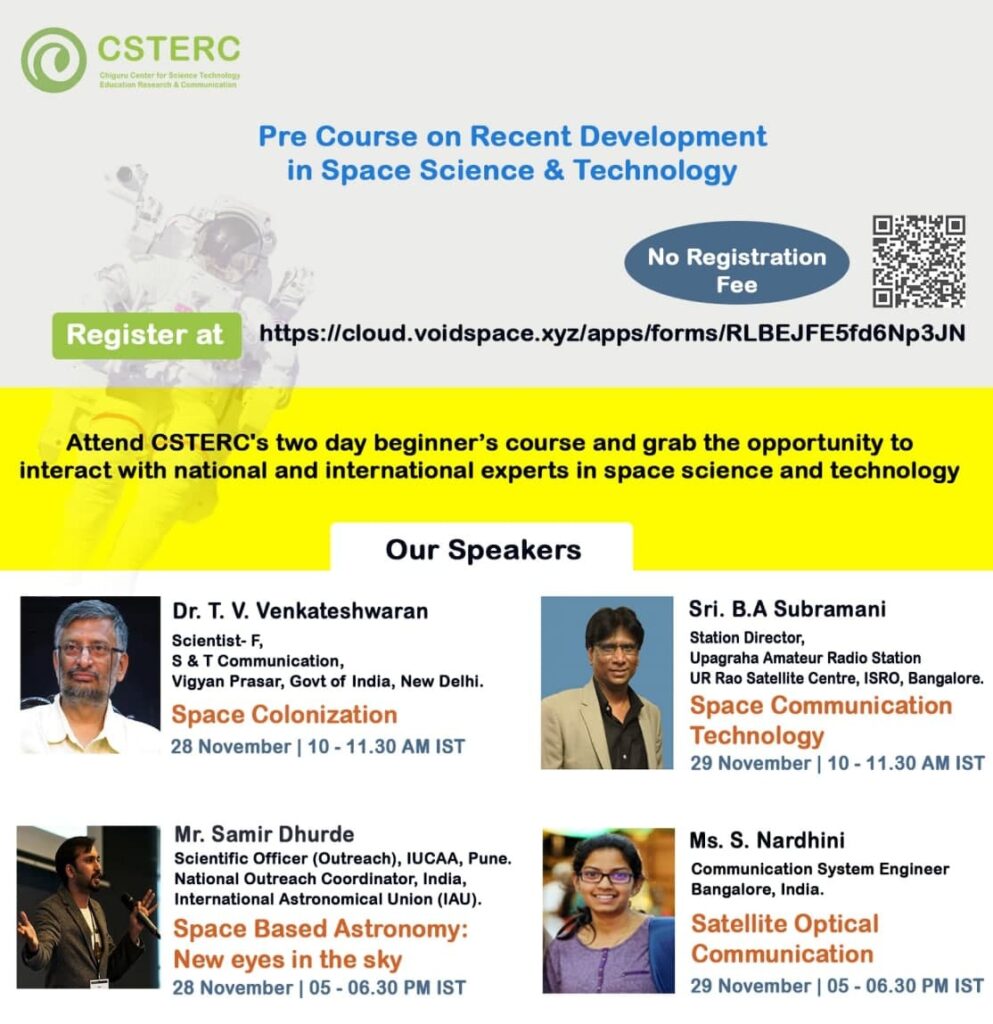
One of our earliest initiatives during this period was the “Pre Course on Recent Development in Space Science & Technology”—our first online course programme, designed to introduce beginners to emerging developments in space science and technology while giving them an opportunity to interact with experienced professionals from India’s scientific and space-technology ecosystem.
Taking Our First Steps into Online Learning
Before the pandemic, much of our educational and public outreach work was conducted through physical workshops, telescope demonstrations, astronomy sessions and direct interactions with students. The lockdown suddenly removed the possibility of gathering people in a classroom or taking our telescopes and activities to schools.
Instead of waiting for normality to return, we decided to experiment with online learning.
The idea was simple: if students could no longer come to us, we would take the learning experience to them.
This led us to organize a two-day beginner-oriented online programme covering selected areas of contemporary space science and technology. We wanted the programme to go beyond introductory astronomy and expose participants to subjects that were directly connected to the future of space exploration, astronomy and communication technology.
Most importantly, we wanted participants to hear directly from people working in these fields.
Bringing Experts to the Virtual Classroom
For our first online course, we were fortunate to bring together resource persons with diverse experiences spanning space science, astronomy, science communication and satellite technology.
Dr. T. V. Venkateshwaran
Scientist-F, S&T Communication, Vigyan Prasar, Government of India, New Delhi
Dr. T. V. Venkateshwaran opened the programme with a session on “Space Colonization.”
The topic offered participants an opportunity to think beyond conventional space missions and explore one of humanity’s most ambitious questions: Could humans eventually establish a sustained presence beyond Earth?
For a beginner-oriented programme, this was a particularly inspiring way to start—connecting present-day space science with the long-term possibilities of human expansion beyond our planet.
Mr. Samir Dhurde
Scientific Officer (Outreach), IUCAA, Pune; National Outreach Coordinator, International Astronomical Union (IAU)
The second session focused on “Space Based Astronomy: New Eyes in the Sky.”
Space-based observatories have transformed our understanding of the Universe by allowing astronomers to observe wavelengths and phenomena that are difficult or impossible to study from the Earth’s surface.
The session introduced participants to the importance of taking astronomy beyond the limitations imposed by our atmosphere and helped demonstrate how space technology has given humanity entirely new ways of observing the cosmos.
Sri. B. A. Subramani
Station Director, Upagraha Amateur Radio Station, UR Rao Satellite Centre, ISRO, Bengaluru
The second day moved into the field of space communication technology.
Sri. B. A. Subramani introduced participants to the fascinating world of communication systems used in the context of space technology. For many beginners, this provided an important connection between the spacecraft they read about and the complex communication infrastructure required to operate them.
Ms. S. Nardhini
Communication System Engineer, Bengaluru
The programme concluded with a session on Satellite Optical Communication.
Optical communication represents an important direction in high-capacity space communications, using light rather than conventional radio-frequency systems for transmitting information. Bringing this subject into a beginner-level programme was particularly valuable because it exposed participants to technologies that could shape the next generation of space communication systems.
A Small Programme with a Bigger Purpose
Although this was our first online course, the intention was bigger than simply conducting a series of lectures.
We wanted to create a bridge between students, emerging learners and professionals working in space science and technology.
The programme demonstrated that online platforms could remove geographical barriers. A learner did not necessarily have to travel to Bengaluru, Pune or New Delhi to listen to someone working in a specialized field. Through an internet connection, a classroom could suddenly extend far beyond its physical boundaries.
For CSTERC, this was an important realization.
The pandemic had taken away our ability to conduct physical programmes, but it also encouraged us to rethink how science education could be delivered.
Learning to Teach Differently
Organizing the programme also became a learning experience for us.
Conducting an online course requires a different approach from organizing a physical classroom session. We had to think about digital registration, communication with participants, coordination with speakers, online session management and keeping learners engaged through a screen.
These may seem like routine aspects of online education today, but at the time, this was a new territory for us.
The programme became one of the first steps in our journey toward developing more structured online science and technology education programmes.
The Beginning of a New Chapter
Looking back, our first online course was not simply another event conducted during the pandemic. It represented a change in the way we thought about science outreach.
The lockdown taught us that scientific education does not always require a physical laboratory, classroom or observatory. Sometimes, a laptop, an internet connection and the willingness to learn can create a classroom that reaches across cities and institutions.
Our Pre Course on Recent Development in Space Science & Technology was one of CSTERC’s first experiments in building that kind of classroom.
It was a modest beginning—but an important one.
The experience we gained during those early online programmes would later influence how we approached digital learning, expert interactions and accessible space-science education.
The world was under lockdown. We were learning how to keep curiosity moving.
And for CSTERC, that was the beginning of our journey into online space science education.